A Tech Pioneer Once Again: Why Steven Soderbergh Is Using AI (Among Other Things) for His Next Film Projects
[10:05 Sat,11.April 2026 by blip]
While many Hollywood directors are giving generative AI a wide berth, Steven Soderbergh is once again showing himself to be very open to this new technology—which is hardly surprising, as he was one of the first to embrace affordable DV cameras early in his career and has recently shot several of his films using iPhones, among other things.
Now, in an interview with *Filmmaker Magazine*, Soderbergh has mentioned that his soon-to-be-completed documentary about the final John Lennon interview will feature some AI-generated images. Furthermore, for his next film project, which is set during the Spanish-American War of 1898, he intends to use AI to generate a large number of warships and similar assets.
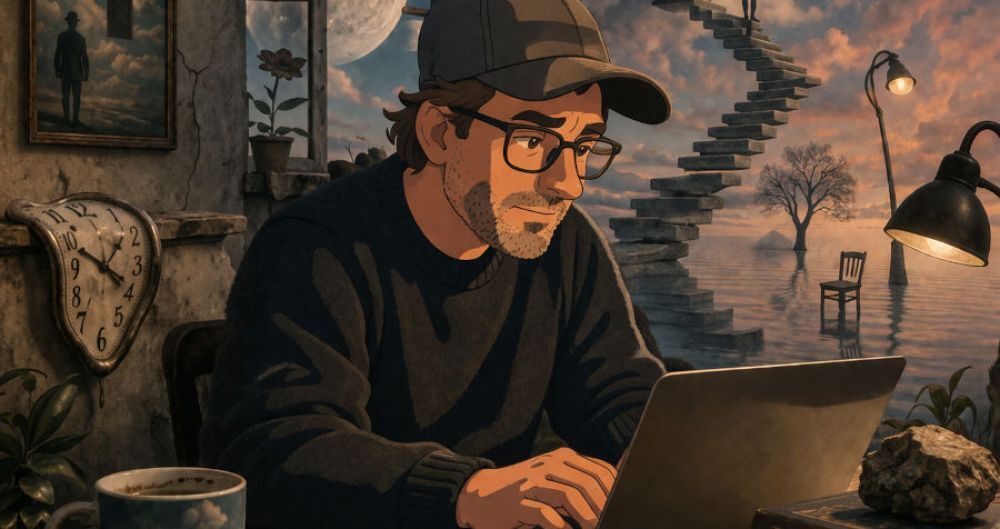
Neither Soderbergh, nor surreal—but AI-generated...
In the latter case, it is strictly a matter of budget—"it’s all about how much I can do it for." While Christopher Nolan can afford to film his odyssey adaptation with reconstructed Viking ships, indie projects simply lack the funds for a real-world realization of such imagery (not to mention elaborate CGI). The easier and cheaper a film is to produce, the more likely it is to be made at all. For this reason, low-budget films often take place in the present day and in familiar, manageable environments, unless a "trash" aesthetic is the goal.
But now, indie filmmakers are increasingly within reach of high-class imagery—via generative AI, which is gradually allowing for more creative control as well. However, in our opinion, the opportunity does not lie in creating entire films that are completely artificial with a naturalistic look (as recently demonstrated by a[historically-themed project by Aronofsky](www.slashcam.de/news/single/Darren-Aronofsky-generiert-per-KI-eine-YouTube-Min-19793.html), which showed how unappealing the result can be). It is much more effective to use AI as a supplement, as Soderbergh is clearly planning to do. In this area, at least, AI tools expand cinematic possibilities that were previously severely limited by budgets—Soderbergh is likely once again at the vanguard here, and others will follow his lead.
It is also interesting to hear what he has to say about the use of AI in the Lennon documentary:
> "It’s worth talking about what that technology might be good at. I’ve been working with AI lately on the John Lennon and Yoko Ono documentary that we’re almost done with. AI has been helpful in creating thematically surreal images that occupy a dream space rather than a literal space. And that’s been really fun because you need a Ph.D. in literature to tell it what to do. But like every other piece of technology, it desperately requires very close human supervision. (...) > Ninety percent of the visuals are archival stills, and 10 minutes, spread out over the 90-minute film, are these little pockets of images we created whenever they start talking philosophically. When there’s no literal component to what they’re saying, then I create these images that are kind of a surreal version of what their words try to transmit."
Accordingly, surreal-looking images were only generated for sequences that were difficult to visualize, and coaxing them out of the machine was clearly not particularly trivial. (Anyone who has tried to generate moving images via prompts that closely match their own vision knows how frustrating that can be.) Little of value comes out automatically at the push of a button when standards are high, which is why generative AI is just another tool in Soderbergh's cinematic toolkit—albeit one with a lot of potential.
Unfortunately, we don't yet know what his surreal AI images actually look like. In principle, however, we believe it is a more exciting approach to create AI images of things or worlds that do not exist in reality, rather than using the generators as a flat replacement for a camera.
The interview itself actually revolves around Soderbergh's current feature film[*The Christophers*](en.wikipedia.org/wiki/The_Christophers_(film)), which will be in US theaters starting in April (though it does not yet have a distributor in Germany). As is often the case, he served as his own cinematographer (no iPhone this time) and also handled the editing.