






[12:26 Sun,19.July 2026 � by Thomas Richter] ��� |
Giving digitally filmed material a "film look" by emulating analog film stock is a classic task in color grading. There are several specialized tools for this purpose, such as Dehancer or Filmbox, but they can be quite expensive. With **spektrafilm OFX**, there is now a free OpenFX plugin for Windows, macOS, and Linux that replicates the photochemical process not via LUTs, but through physically based spectral simulation, and it can be used in DaVinci Resolve.  spektrafilm OFX
Spectral simulation instead of LUTsThe technical approach distinguishes spektrafilm from most film-look tools: instead of mapping RGB values directly to other RGB values, the plugin interprets the incoming RGB value as an indication of scene light, projects it through the film&s spectral sensitivity curves, develops film density from it, optically exposes this onto a second emulsion (the print), and finally scans the result back to RGB. Controls such as printer lights, preflash, push/pull, halation, and grain therefore act at different points in this virtual process chain—and behave differently than simple look sliders. According to the developer, the data basis comes from real manufacturer datasheets: 17 camera negative stocks (including Kodak Vision3, Portra, Ektar, and Fujifilm negatives) and 9 print stocks or papers (including Kodak 2383/2393 and Endura) were modeled from density curves, spectral sensitivity, and dye density data. Grain is calculated format-dependently as part of the negative simulation—from 8mm to 70mm—as is halation, which is rendered as red-tinted scattering before density formation. Additionally, there are camera diffusion filters (such as Black Pro-Mist), scanner effects, LUT export, and the ability to pass real Cineon/DPX and ADX negative scans through the print stage. 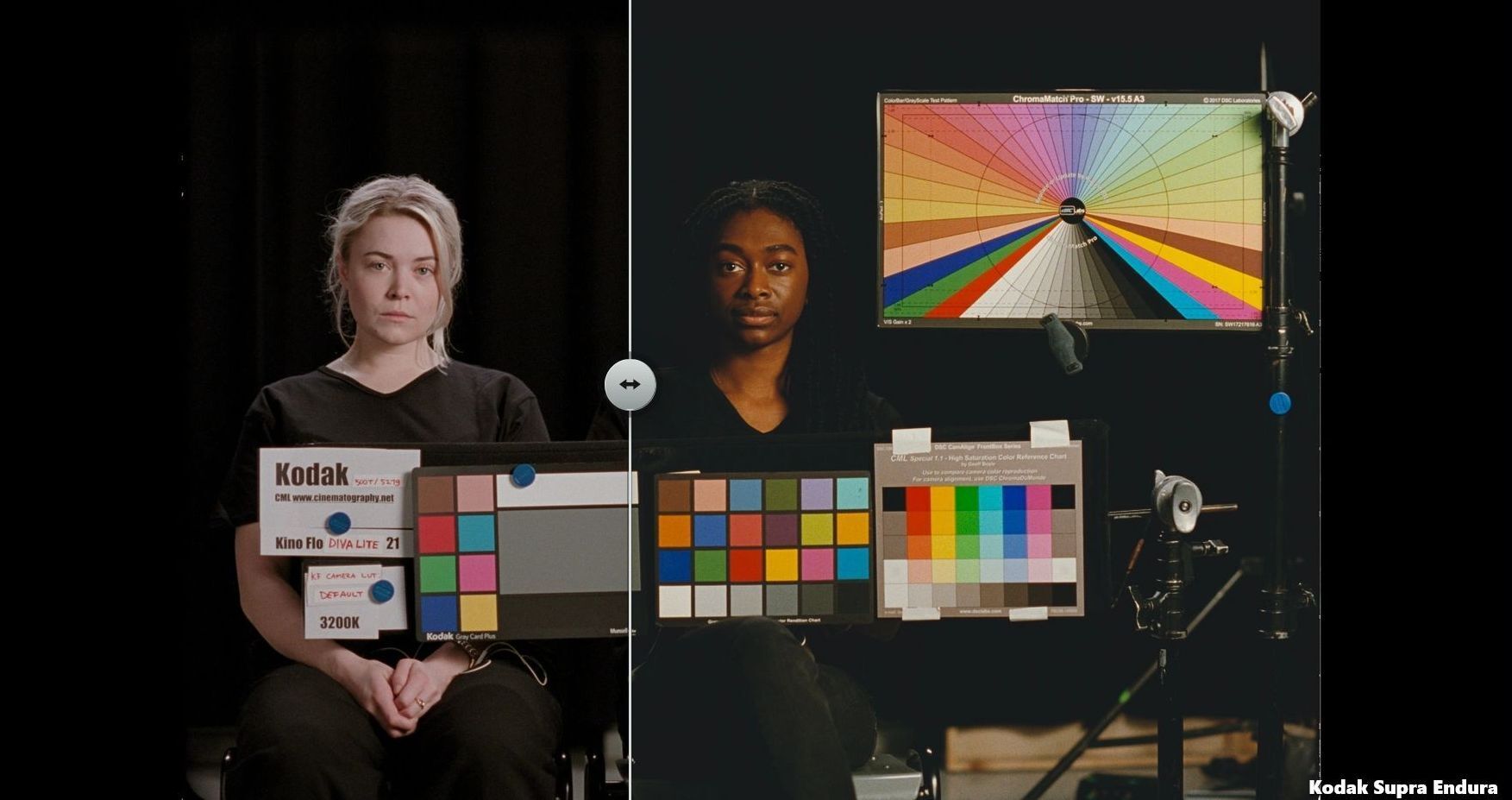 The spektrafilm OFX plugin is based on the open-source research project  spektrafilm by KTH researcher Andrea Volpato and uses Apple&s Metal GPU stack on macOS, as well as Vulkan Compute on Windows and Linux. It comes in two versions: the full version with all physical parameters and the reduced "spektrafilm-flow" for quick look-building with a feature set trimmed of some more complex parameters and functions—though both use the identical engine. spektrafilm by KTH researcher Andrea Volpato and uses Apple&s Metal GPU stack on macOS, as well as Vulkan Compute on Windows and Linux. It comes in two versions: the full version with all physical parameters and the reduced "spektrafilm-flow" for quick look-building with a feature set trimmed of some more complex parameters and functions—though both use the identical engine. A free alternative to Dehancer and other film-look emulatorsIts multitude of functions and emulations positions spektrafilm OFX as a free alternative to commercial solutions like the popular Dehancer, especially since the latter&s pricing policy has recently caused resentment: while the perpetual license cost 299 euros a short time ago, the price has since been drastically increased to 999 euros for individuals and 1999 euros for companies. The open-source project spektrafilm, on the other hand, is donationware—those who wish can support the developer via Ko-Fi.  spektrafilm OFX The well-known film-look emulationsIn addition to Dehancer, there are other solutions such as Filmbox from Video Village, which is also expensive at 129 dollars per quarter, 349 US dollars per year, or 999 dollars for a lifetime license—at least the simplified "Looks" variant is significantly more affordable at 29 dollars per quarter, 69 dollars annually, or 199 dollars. Free, though less feature-rich, alternatives like specialized film emulation tools are integrated into many editing programs. Since version 19, DaVinci Resolve has offered the Film Look Creator (also in the free version) with halation, grain, gate weave, and flicker—effects that are supplemented in the Studio version by ResolveFX Film Grain and Film Damage. Powerful, but difficult to use?Unfortunately, using spektrafilm OFX is not (yet) without its drawbacks. The plugin is in beta, and the version number differs from platform to platform—improved 4K playback performance—so real-time capability on the timeline should not be expected everywhere (yet). Black-and-white profiles and bleach bypass are currently missing. Above all, the learning curve is steep: our forum reports "massive usability problems"—a multitude of parameters whose effects are difficult to understand without expert knowledge of analog film development, and default results that, depending on the source material, may not be immediately pleasing. Other users, however—for example with Apple Log 2 in DaVinci YRGB—achieve usable results right away and praise the harmonious negative/print combinations like Vision3 50D plus Kodak 2383. As with any physically modeled tool, the rule applies: those who understand the photochemical process get significantly more control here than with a LUT—those just looking for a quick film look are better served with the "flow" variant or must be prepared to invest time in learning. Versions and platformsSpektrafilm OFX is currently available for macOS in version 0.3.5 (Universal Binary from macOS 11, GPU-accelerated via Metal), while the Windows and Linux builds are two patch versions behind at v0.3.2 and use Vulkan instead of Metal—a stable Windows build is still pending according to the roadmap, so one should expect beta-typical limitations there. In addition, there is a very early standalone photo app for macOS 15 (v0.0.1) with a project and preset system, which is explicitly intended as a preview for gathering feedback, as well as an announced iOS version that is intended to expand the iPhone camera with spektrafilm functions, though no details are known yet. Bild zur Newsmeldung:
 �more infos at bei spektrafilm.114c.de �more infos at bei spektrafilm.114c.dedeutsche Version dieser Seite: spektrafilm OFX - kostenlose Filmemulation für DaVinci Resolve |

 |
|
|